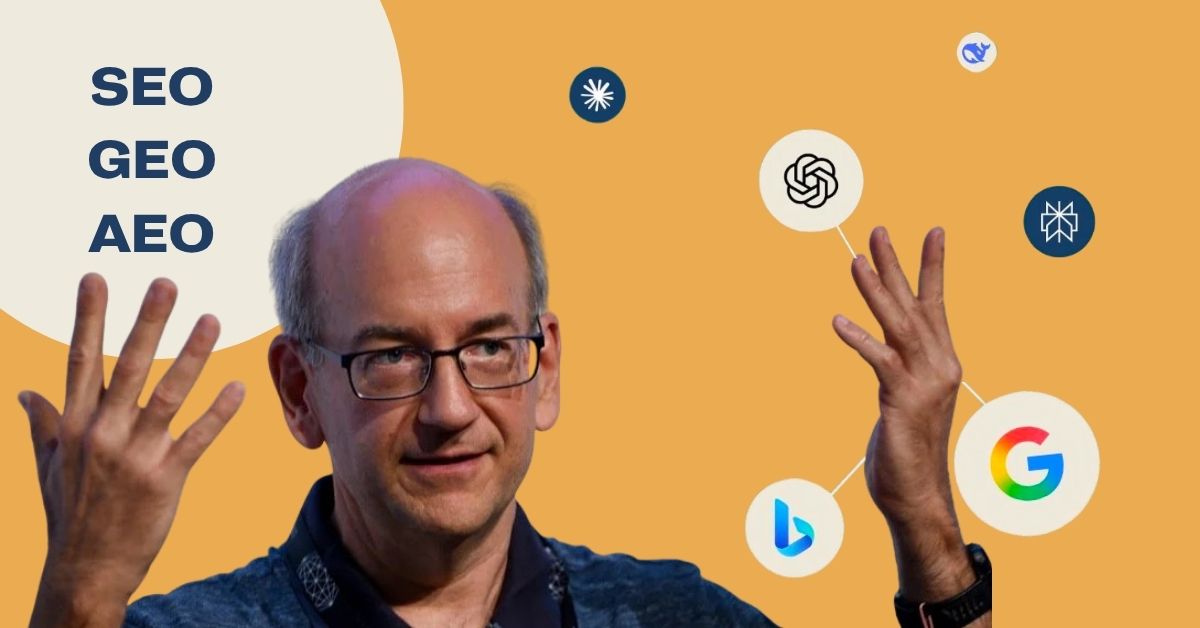


The arrival of ChatGPT, Gemini, Perplexity, and Google's AI Overviews has sent shockwaves through the digital marketing world. Overnight, panic set in: Is SEO dead? Do we need to scrap everything and start over?
At Bofu, our answer is clear and direct: absolutely not. While the display rules are changing, the foundations remain solid. Today, to generate online revenue, you no longer just need to please traditional search engines (SEO). You must become the preferred source of information for answer engines (AEO) and generative engines (GEO).
Here's a comprehensive guide to understanding this evolution, discovering why our business objectives-based methodology dominates current algorithms, and how to position your brand in AI responses.
SEO, AEO, GEO: What exactly are we talking about?
To simplify the situation, we need to understand the playing field. Gone are the days of stuffing a page with keywords to get a click. Today, search is conversational and synthetic.
-
SEO (Search Engine Optimization): The art of technically and semantically optimizing a site so that it is indexed, understood, and ranked by Google. It's the foundation of the house.
-
AEO (Answer Engine Optimization): Optimization for answer engines (like Featured Snippets or voice assistants). The goal is not to get a click to your site, but to provide the direct answer to a specific question.
-
GEO (Generative Engine Optimization): The most recent layer. This is optimization aimed at being cited as a reliable source by large language models (LLMs) like ChatGPT or Google's AI Overviews, when they generate a text summary for the user.
John Mueller confirms what we've been explaining since the rise of AI search
Since the advent of AI search, marketing "gurus" have been in a frenzy, promising miraculous tricks to hack ChatGPT.
At Bofu, we have stayed true to our philosophy: no gadgets, just content that serves business objectives.
Recently, John Mueller, Search Advocate at Google, set the record straight. He loudly reiterated a truth we have been preaching for years: artificial intelligence is primarily based on the foundations of traditional SEO.
AI is not omniscient. It does not create truth; it synthesizes it from the web. If your website is slow, poorly structured, riddled with technical errors, or your content is thin, no artificial intelligence will find you, let alone cite you.
The Bofu method: The TOFU-MOFU-BOFU funnel applied to AI
The added value of Bofu, what fundamentally differentiates us in the market, is that we do not optimize for algorithms; we optimize for your business objectives. We structure our SEO/GEO work around your customers' journey, following a precise funnel. And guess what? This is exactly how generative AIs learn to trust a brand.
TOFU (Top of Funnel): Educating AI to build the brand
This is the long game. People (and AIs) are looking for answers to broad questions. The audience is qualified, but not yet ready to buy today.
-
Our action: We create high-quality educational content. We plant the seed.
-
The AI result: This is where strong brands are built. By feeding AI with your definitions, guides, and expertise, you become its standard of reference. You become top of mind.
MOFU (Middle of Funnel): Dominating the comparison
Here, the intent is strong. The user is looking for a product or service, but they are evaluating their options.
-
Our action: Data structuring, creation of clear service pages, detailed comparisons, frequently asked questions (FAQ).
-
The AI result: LLMs love logical structures. By properly formatting information, we enable AI to easily extract your arguments to position you against your competitors.
BOFU (Bottom of Funnel): Pure conversion
This is the 5% of the market ("in-market"). The conversion intent is maximal. These are direct searches for your brand or specific products.
-
Our action: Frictionless transactional landing pages.
-
The secret of AI: AI will never recommend you at the BOFU level if it hasn't encountered you at the TOFU and MOFU levels. It is because we have done the educational work upstream that AI naturally associates your brand with the final solution sought by the user.
Case study: Dominating your market in under 2 years
To illustrate the power of this approach combining business SEO, AEO, and GEO, let's look at the results of one of our recent clients.
Context: A company less than two years old, operating on a Shopify platform, that sells, installs, and maintains Kohler generators in the Laurentians.
The Bofu strategy: Instead of simply publishing an online store, we built a complete content ecosystem aligned with the business funnel:
-
A robust product catalog (BOFU).
-
Local landing pages by services and intervention cities (BOFU/MOFU).
-
Strategic blog articles answering all peripheral questions: power selection, propane operation, preventive maintenance, etc. (TOFU/MOFU).
The results (SEMrush Proofs): Applying Pareto's law, we targeted "Top 5" positions for 20% of the regional industry's keywords that generate 80% of qualified traffic. The results are striking:
-
Exponential organic traffic: Nearly 11,000 monthly visitors generated organically.
-
Classic SEO dominance: #1, #2, and #3 positions for highly competitive queries like "propane generator," "kohler generator canada," and "generator installation Laval."
-
The GEO/AEO jackpot: The site is massively cited as a source by artificial intelligences to answer user questions. Our analysis tools show that across all AI-generated mentions:
-
60% come from ChatGPT
-
35% come from Google's AI Overviews
-
Why does ChatGPT recommend this client for buying a generator in Quebec? Because we built the brand's authority from the TOFU phase.
5. How to concretely optimize your site for AI?
To prove your E-E-A-T (Experience, Expertise, Authoritativeness, Trustworthiness) according to Google's criteria, here are 3 golden rules to apply today:
-
Answer the question immediately (BLUF): The military acronym Bottom Line Up Front is king in AEO. Give the short, direct answer in the first paragraph, then detail the "how" and "why" afterwards.
-
Structure your data surgically: AIs are machines. They love H2/H3 tags, bulleted lists, comparative tables, and structured data tags (Schema.org). Do the work for them.
-
Provide a unique perspective (Information Gain): ChatGPT doesn't need another article that repeats Wikipedia. It needs data from your customers, your case studies, the strong opinion of your experts. It's human experience that will get you cited.
Don't let AI recommend your competitors
Optimizing for generative engines is no longer a futuristic option; it's an immediate necessity. If you don't educate AI about your expertise today, it will turn to your competitors' data tomorrow.
At Bofu, we don't do technical magic; we translate your business objectives into a language that search engines and artificial intelligences understand and reward.
Ready to dominate your market and become ChatGPT and Google's number one recommendation in your industry? Contact us!